Why Customers Hang Up Instead of Leaving Voicemail (2026)
Most customers hang up instead of leaving voicemail. Discover the real reasons why and proven tactics to stop losing calls to your competitors.
February 10, 2026
You check your call log after business hours and see 12 missed calls. Only one person left a voicemail.
What happened to the other 11? They're gone. Most of them called your competitor, and you didn't even know they existed.
If you think this sounds dramatic, consider this: a September 2025 survey of 1,000 U.S. consumers found that when businesses don't answer, only 42% leave a voicemail. Meanwhile, 21% immediately call another business, and 24% turn to online chat instead.
Even worse? 78% of people have taken their business elsewhere after failing to reach a company by phone.
The problem isn't just that voicemail is annoying. It's that voicemail has become a leak in your sales funnel, and most small businesses don't realize how much revenue is slipping through.
This guide will show you exactly why customers hang up instead of leaving voicemails, what they do instead, and most importantly, how to stop losing those calls without hiring a full-time receptionist.
What Do Customers Do When You Don't Answer?#
When your phone goes to voicemail, customers don't sit around waiting patiently. They take action, and it's usually not in your favor.
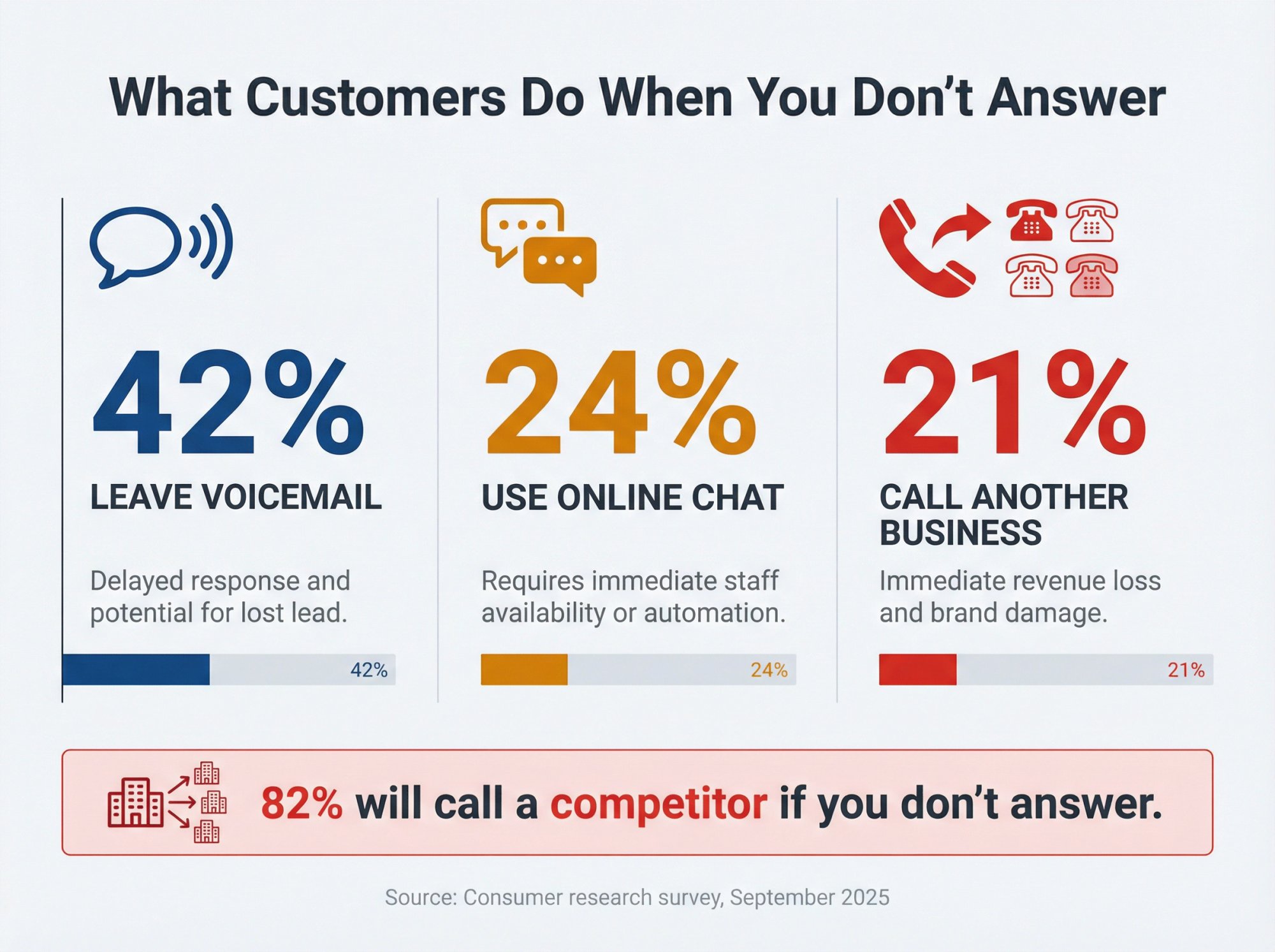
| What customers do when you don't answer | % of people | What it means for you |
|---|---|---|
| Leave a voicemail | 42% | You get a second chance (but no guarantee they'll wait) |
| Use online chat | 24% | They're still interested but switching channels |
| Call another business immediately | 21% | You just lost the sale |
Source: Consumer research survey, September 2025
The math gets worse when you dig deeper. 82% say they'll call a competitor if you don't answer. That means for every 10 calls you miss, roughly 8 people are already reaching out to someone else before you even check your voicemail.
You're not just missing calls. You're funding your competitors' growth.
Why Do Customers Hang Up Instead of Leaving Voicemail?#
Most articles stop at "people hate voicemail." That's true, but it's not useful. The better question is: What calculation is the caller making in that moment, and why does hanging up feel like the best move?
They don't believe voicemail leads to a fast response#
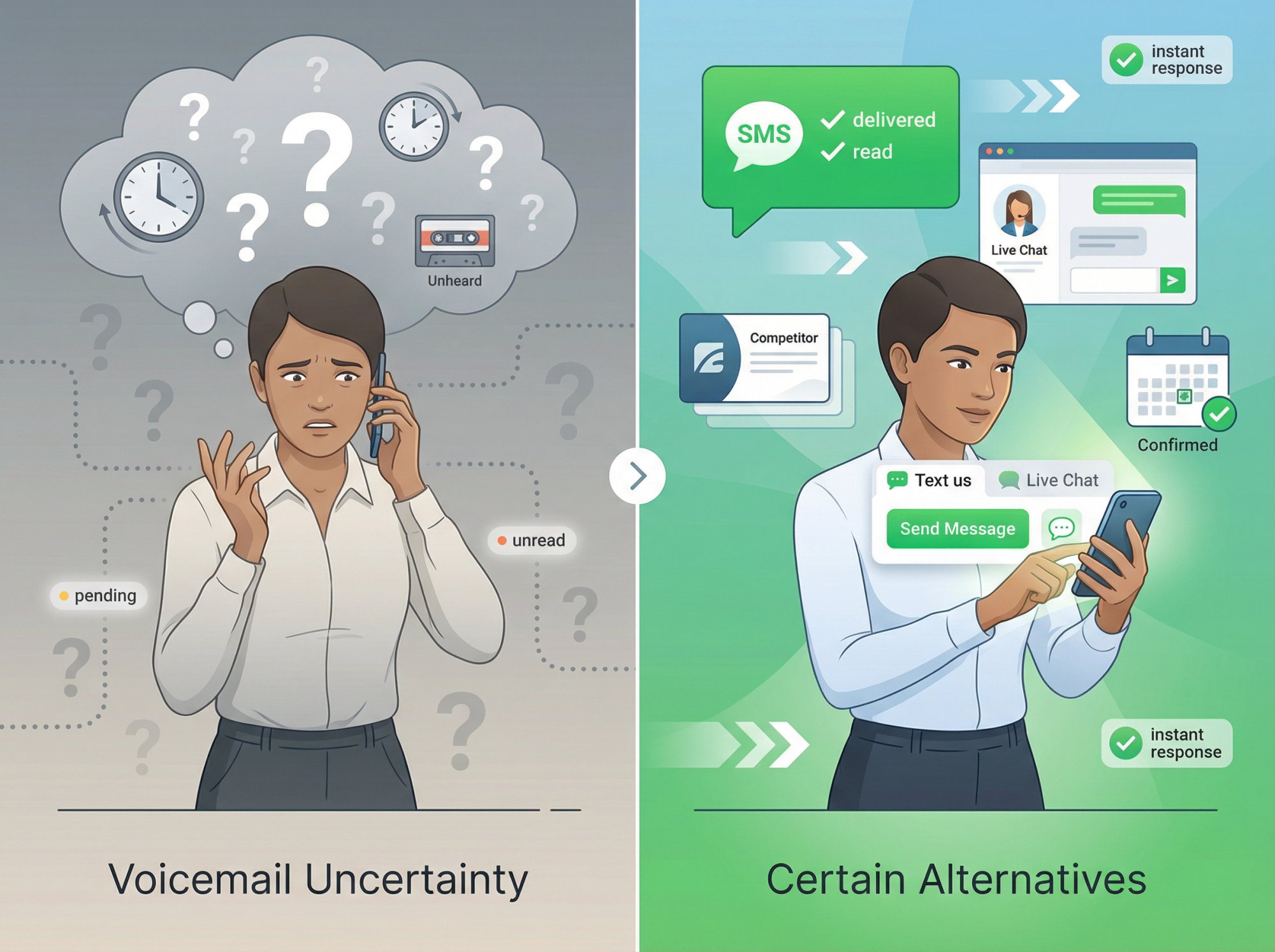
Voicemail is fundamentally a low-certainty channel. When someone leaves you a message, they don't know:
• If you'll listen today, tomorrow, or ever
• Who will call them back (or if the callback number will look like spam)
• Whether they'll have to repeat everything anyway
Compare that to texting a friend. You see "delivered." You see "read." You know they got it. Voicemail offers none of that.
This aligns with broader consumer patience data. A November 2025 benchmark survey found that 54% of people hang up within 8 minutes on hold, with phone/SMS response expectations measured in minutes, not hours. Even if your business isn't running a call queue, the mindset carries over. Waiting feels like a tax, and people won't pay it when they have other options.
They're comparing options, and the first answer wins#
In high-intent categories (plumbing, HVAC, legal intake, real estate), callers are often contacting multiple providers at once. If you don't answer, they're thinking:
"I might hear back later... or I could call the next business and solve this now."
It's not personal. It's rational. Your voicemail greeting is competing against a live human at your competitor's office. That's not a fair fight.
Leaving a voicemail has too much friction for the payoff#
Leaving a voicemail is surprisingly demanding:
→ You have to speak clearly, in order, with no visual cues
→ You can't edit easily
→ You must remember details (address, availability, symptoms of the problem) while under pressure
If the perceived payoff is uncertain, people won't invest that effort. This is one reason text wins. It's editable, quiet, and controllable. YouGov's February 2024 research found that 68% of Americans prefer sending text messages compared to audio messages.
They prefer channels that confirm receipt#
Voicemail provides no confirmation:
• No "delivered"
• No "seen"
• No "we'll be back to you by..."
Text, chat, and forms all provide at least a minimal sense of progress. The lack of confirmation is so frustrating that in a June 2024 YouGov study about preferred channels for data breach notifications, only 1% preferred voicemail. That's not a typo. One percent.
They're in a place where leaving a voicemail is awkward or impossible#
Common situations:
-
At work or in a meeting
-
In public
-
In a noisy environment (job site, car, store)
-
With kids asleep
-
With poor cell signal
Text is silent. Voicemail is not. So they hang up and tell themselves they'll do it later. And "later" becomes never.
They don't want to share sensitive details on a recording#
Even when the topic isn't highly sensitive, callers often avoid leaving:
• Full names
• Addresses
• Claim details
• Budgets
• Legal problems
This is especially true if your greeting mentions recording or sounds like a generic voicemail box. Nobody wants their personal information floating in a system they don't trust.
Scam calls have trained people to distrust phone communication#
Robocalls and spoofing changed behavior. A May 2025 TNS/Kantar survey found that:
• 76% prefer to engage with businesses that brand their calls
• 75% missed calls from unknown numbers they would have answered if they knew who was calling
This matters for voicemail because voicemail is part of the same trust ecosystem. If callers assume "phone = risk," they'll avoid leaving voice recordings and prefer written channels.
Your voicemail experience may be silently pushing people away#
Sometimes it's not voicemail in general. It's your voicemail specifically.
Common issues that drive hang-ups:
-
The greeting is long, unclear, or unprofessional
-
It doesn't say when you'll call back
-
It doesn't offer an alternative (text/email/booking link)
-
It asks for too much ("please leave your full details...")
-
The mailbox sounds full (or they suspect it's full)
-
The system sounds like an IVR maze
If your greeting doesn't reduce uncertainty, it increases hang-ups.
A Simple Framework: The "Voicemail Value Test"#
To understand hang-ups, evaluate voicemail through your customer's lens.
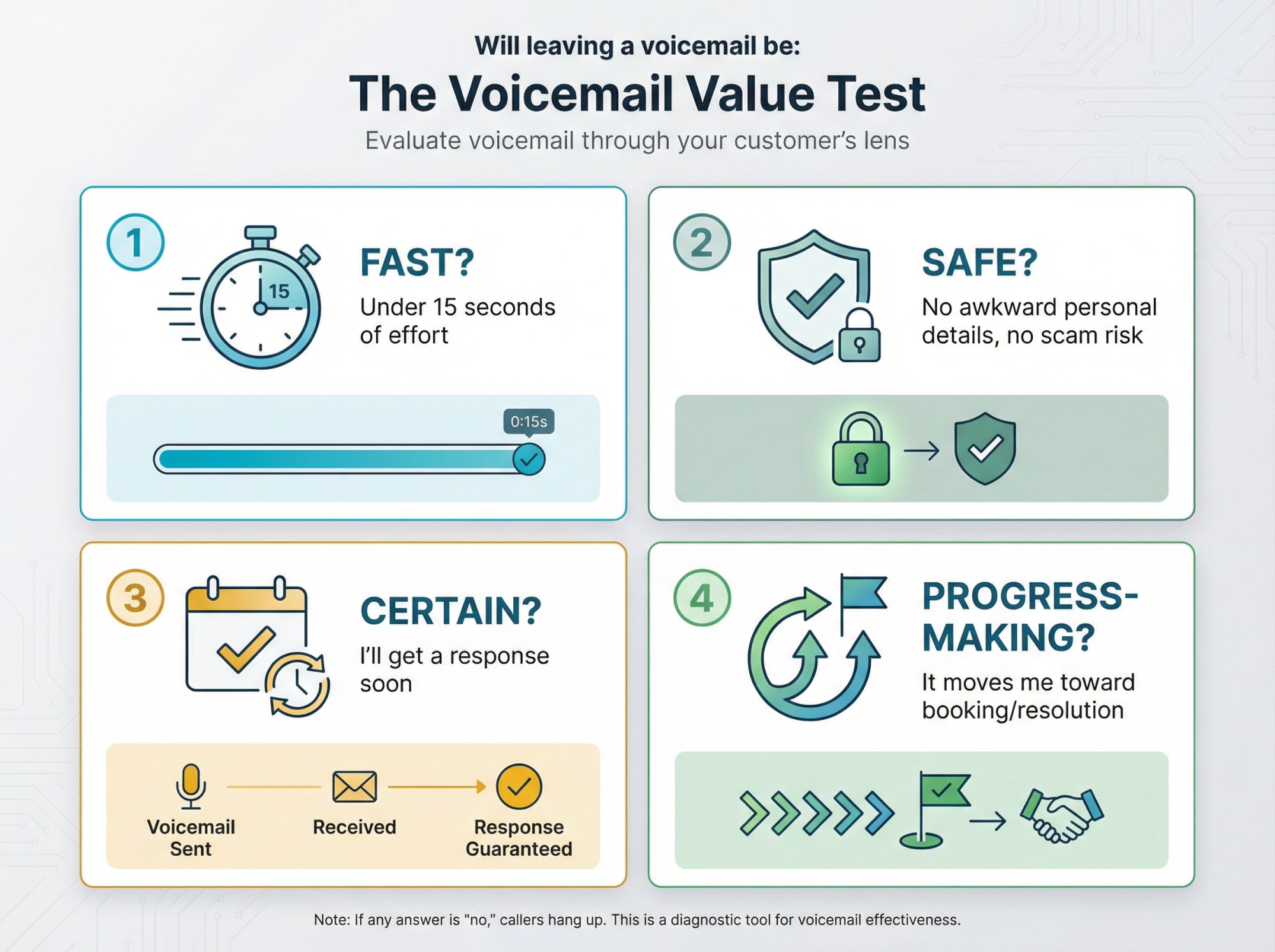
Will leaving a voicemail be:
| Criteria | Question | What It Means |
|---|---|---|
| ① Fast? | Under 15 seconds of effort | Minimal time investment required |
| ② Safe? | No awkward personal details, no scam risk | Caller feels secure sharing info |
| ③ Certain? | I'll get a response soon | Clear expectation of follow-up |
| ④ Progress-making? | It moves me toward booking/resolution | Tangible step forward in solving problem |
If any of those are "no," callers will choose a different path. Your job is to redesign the call experience so the answer becomes "yes."
How to Diagnose Your Missed Call Problem#
To fix hang-ups, you need to measure them. Here's a simple 30-60 minute audit any SMB can run.
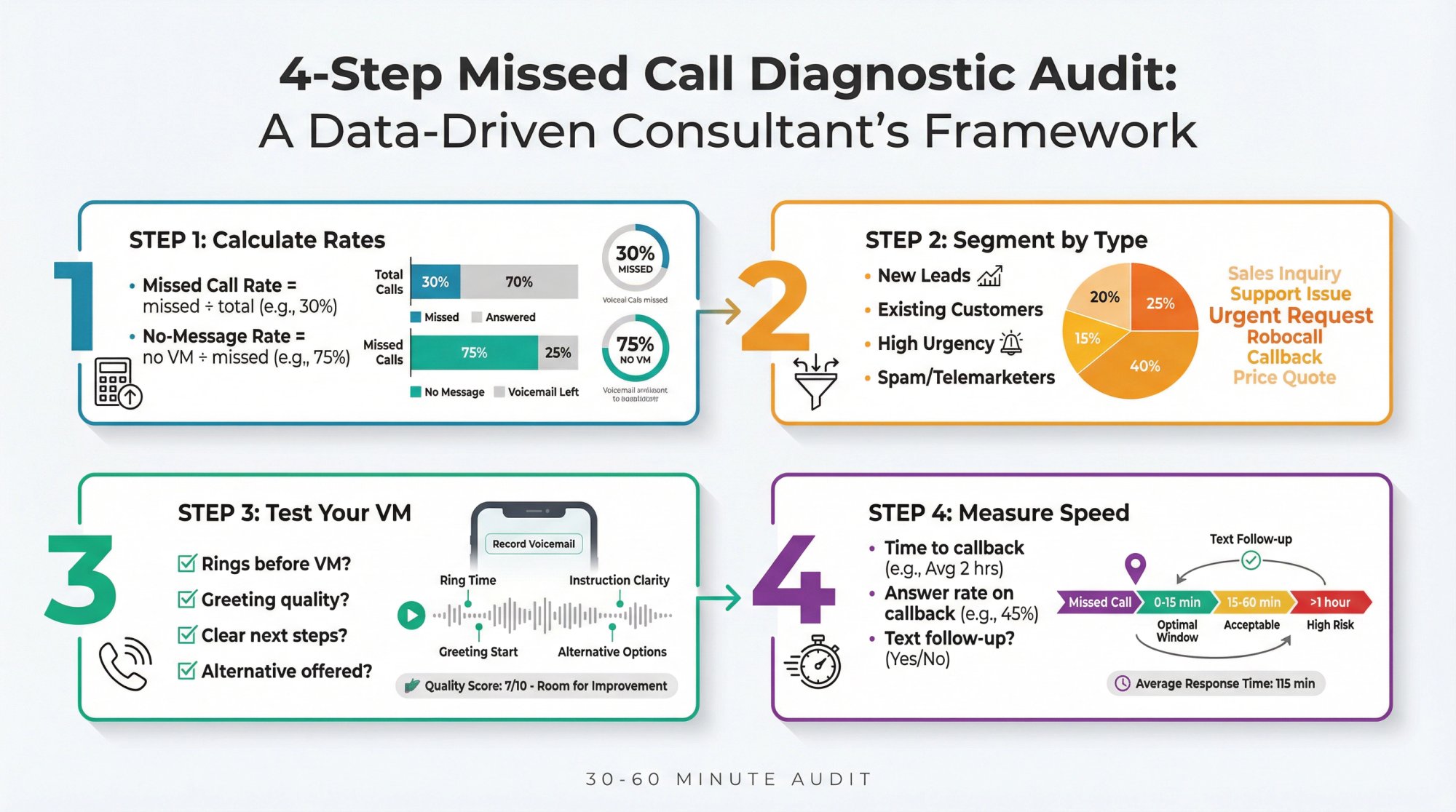
Step 1: Calculate your "No-Message Missed Call Rate"#
Pull the last 7-14 days of data:
• Total inbound calls
• Missed calls
• Missed calls with voicemail
Then compute:
Missed Call Rate = missed calls ÷ total inbound calls
No-Message Missed Call Rate = missed calls with no voicemail ÷ missed calls
This tells you whether the main issue is that you're missing calls, people aren't leaving messages, or both.
Step 2: Segment by call type#
Tag missed calls by likely intent:
① Net-new leads (unknown numbers, Google Business profile, ads)
② Existing customers (repeat numbers)
③ High urgency (after-hours, weekends, short calls, repeated attempts)
④ Spam/telemarketers
If you don't have a system, even a basic notes spreadsheet is enough.
Step 3: Mystery-shop your own voicemail#
Call your business number from a phone you don't normally use. Ask yourself:
-
How many rings before voicemail?
-
Does the greeting sound modern and confident?
-
Does it tell me what to do next?
-
Does it offer another path (text/booking)?
-
If I leave a message, what happens next?
You'll usually find at least one obvious friction point.
Step 4: Measure response time#
Track your "time to first response" for missed calls:
• How long until you call back?
• If you call back, do they answer?
• If they don't answer, do you text?
If you can't respond quickly, voicemail will always underperform because your customer's problem is time-sensitive (even if it's not an "emergency").
How to Stop Customers from Hanging Up: Proven Tactics#
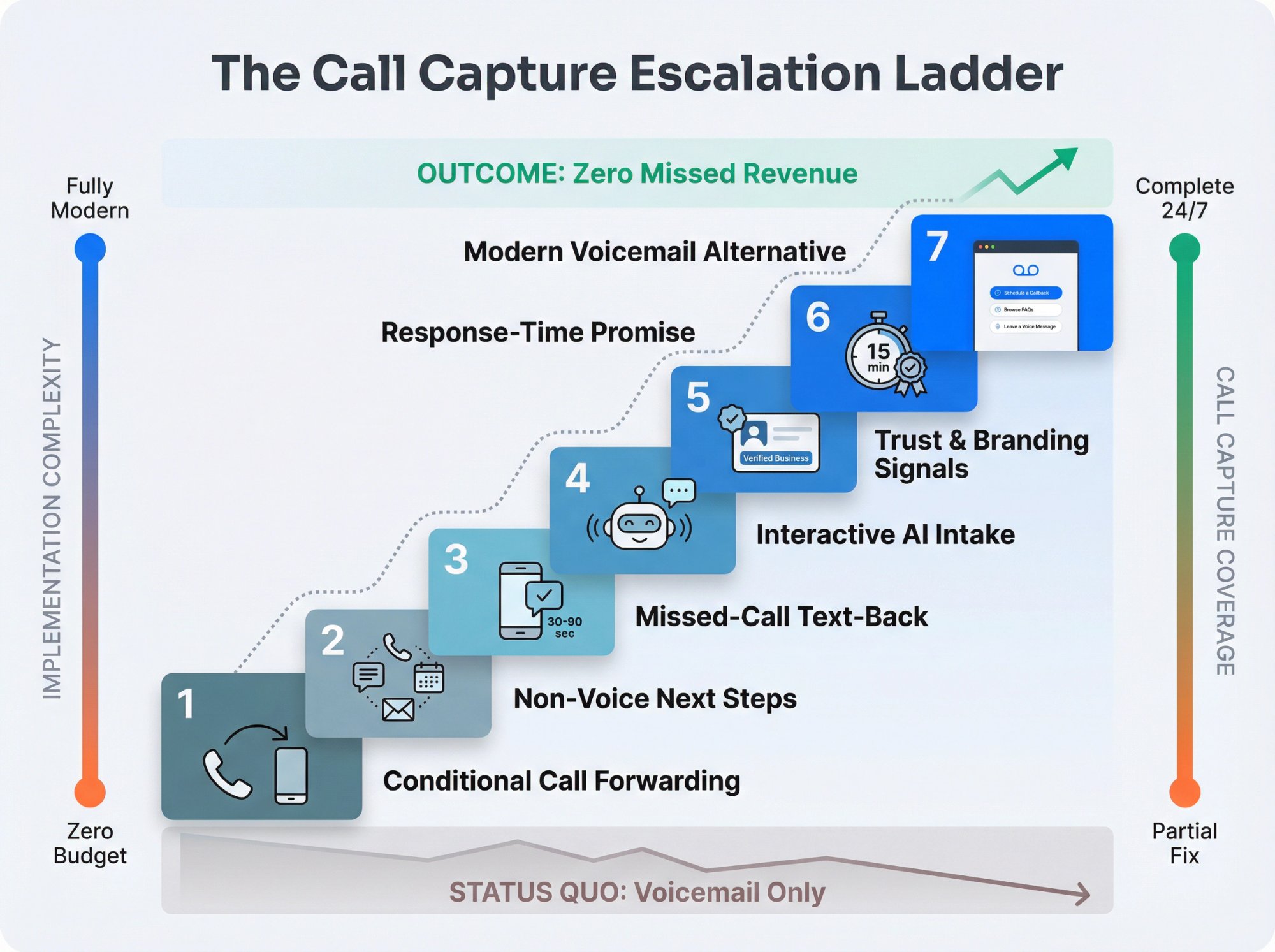
Below is a practical playbook, from "zero budget" to "fully modern."
1. Reduce time-to-human with conditional call forwarding#
If your phone only has two modes (answered or voicemail), callers will keep disappearing. A better model is:
Answered → Great.
Not answered → auto-forward to backup answering (human or AI) before voicemail.
This is exactly what conditional call forwarding is designed for. Your phone rings normally, but if you don't answer (or you're busy/unreachable), calls forward to a backup number instead of dropping into voicemail.
If you want a deeper technical walkthrough, Eden's call forwarding guide breaks down unconditional vs. conditional forwarding and how to set it up.
2. Give callers a "next step" that doesn't require talking#
If your customers won't leave a voicemail, don't force them to.
Offer alternatives:
• "Text us for faster scheduling"
• "Book online"
• "Chat now"
Even if they called first, many will happily switch channels as long as it's frictionless. Research shows a meaningful share of consumers do exactly this when calls aren't answered.
3. Add a missed-call text-back workflow#
This is one of the highest ROI fixes for SMBs. When you miss a call, send an SMS within 30-90 seconds:
→ Acknowledge you missed them
→ Offer 2-3 quick response options
→ Provide a booking link or ask for best callback time
The goal is to create certainty.
Example missed-call text templates (copy/paste):
Hi - sorry we missed your call. This is [Business Name].
What can we help with?

Reply 1 for a quick callback
Reply 2 to schedule a time
Reply 3 for a quote request
Sorry we missed you - can you share (1) your name and (2) what you need help with?
If you prefer, reply with a good time to call you back today.
We can get you on the schedule fast. What are you looking for?
A) ASAP / urgent
B) This week
C) Just a quote
4. Replace voicemail with an interactive intake (AI or human)#
If your business depends on inbound calls, the best "voicemail alternative" isn't a better voicemail. It's a conversation that captures the lead.
Consumer research shows people are increasingly comfortable with AI voice assistants for low-stakes tasks like checking hours or booking. The best systems do more than "take a message." They:
• Ask clarifying questions
• Capture the caller's intent
• Route urgency correctly
• Schedule (or queue) next steps
This is where AI receptionists like Eden come in. Instead of sending calls to voicemail when you're unavailable, Eden answers 24/7 with natural conversation, captures lead information, sends scheduling links, and even books appointments directly into your calendar.
Many SMBs use conditional call forwarding to send unanswered calls to Eden instead of voicemail. Your phone rings normally when you're available, but if you can't answer, calls go to a live AI assistant instead of a dead-end recording.
5. Improve trust signals: caller ID reputation and call branding#
When trust is low, voicemail performance drops because callers assume the whole phone channel is unreliable. TNS/Kantar research indicates strong consumer preference for branded calling and highlights how unknown-number distrust drives missed connections.
You don't need enterprise tooling to improve trust, but you should:
-
Use a consistent business number (don't call back from random cell numbers)
-
Keep your Google Business Profile accurate
-
Consider branded calling solutions if outbound calling is a big part of your workflow
6. Set (and meet) a response-time promise#
Even if you can't answer every call, you can reduce uncertainty. If you commit to "callbacks within 10 minutes," you must be ready to deliver on it.
Research suggests consumers increasingly expect very fast responses across channels, with phone/SMS expectations measured in minutes, not hours.
Practical promise examples:
"If you call during business hours, we call back within 15 minutes."
"After hours, we'll text you within 5 minutes and call first thing tomorrow."
7. Keep voicemail as a "last resort," but make it short and modern#
If you must keep voicemail, treat it like a landing page:
• Short
• Clear
• Action-oriented
• Low friction
Voicemail Scripts That Actually Work in 2026#
Script 1: The "fast certainty" voicemail (best default)#
Hi, you've reached [Business Name]. Sorry we missed you.
Leave your name, number, and what you need - we'll call you back within [X] minutes during business hours.
If it's easier, text this number with your request and we'll respond ASAP.
Why it works: Sets expectations, offers a non-voicemail channel, keeps the ask minimal.
Script 2: After-hours voicemail (captures urgency)#
Hi, you've reached [Business Name]. We're currently closed.
Leave your name, number, and what you need.
If this is urgent, text "URGENT" plus your address and issue to this number, and we'll respond as soon as possible.
Why it works: Preserves urgency routing and moves urgent needs to SMS (faster and quieter).
Script 3: Professional services intake (reduces privacy fear)#
Hi, you've reached [Business Name]. Sorry we missed your call.
You don't need to share sensitive details here - just leave your name, number, and the best time to call you back.
Why it works: Reduces the "I don't want to say this on a recording" barrier.
Industry-Specific Solutions#
Home services (plumbing, HVAC, electrical, roofers, cleaning)#
| Aspect | Details |
|---|---|
| Primary hang-up drivers | Urgency + comparison shopping |
| Fix | Prioritize instant triage and routing |
| Key tactics | Conditional forwarding during field work "Urgent vs non-urgent" quick intake Offer immediate booking slots if possible |
Industry-specific solutions:
• AI receptionist for plumbers
• AI receptionist for HVAC companies
• AI receptionist for electricians
Law firms#
| Aspect | Details |
|---|---|
| Primary hang-up drivers | Privacy + urgency + fear of being "sold" |
| Fix | Confidential, structured intake |
| Key tactics | Reduce sensitive details required Provide immediate next step (consult scheduling) Capture call reason category, not full story |
Learn more: AI receptionist for law firms
Real estate#
Primary hang-up drivers: speed + competition
Fix: fast lead capture + follow-up automation
① Capture name, buying/selling, timeline
② Offer showing/consult booking or callback time windows
Learn more: AI receptionist for real estate agents
Agencies / B2B services#
Primary hang-up drivers: "not worth the effort" + uncertainty
Fix: remove friction and add certainty
-
Short intake + calendar booking
-
Quick answers to FAQs (pricing ranges, timelines, availability)
How Eden Stops Your Business from Losing Calls#
There are three broad ways to solve the voicemail hang-up problem:
① Hire/extend human coverage (in-house or outsourced)
② Build a multi-channel "text + booking + callback" system
③ Use an AI receptionist to answer and capture leads 24/7
Eden sits in option #3 and is designed for SMBs that want "live answering" outcomes without building a call center.
How it works#
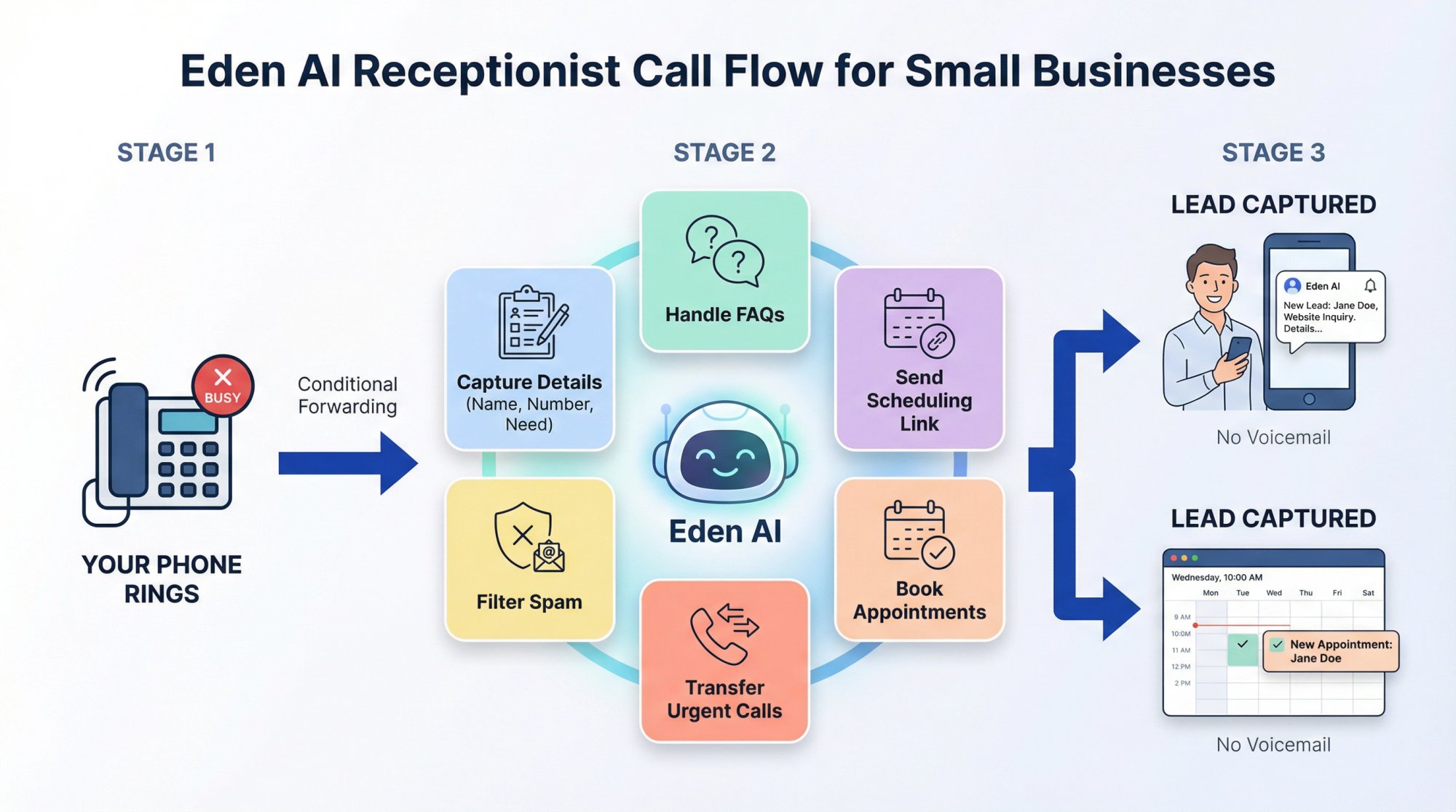
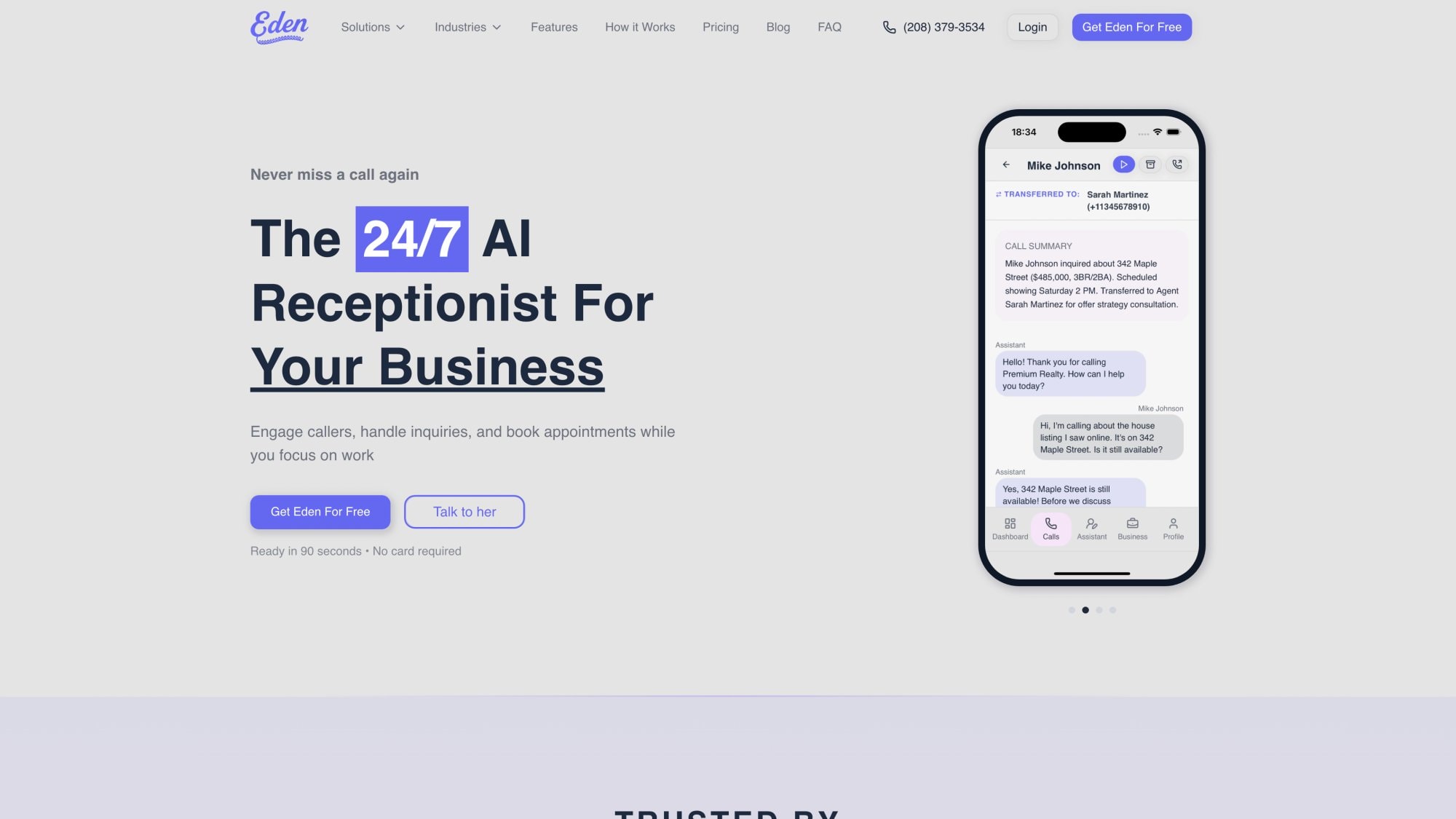
Here's what the actual Eden platform looks like:
A practical way many SMBs start is:
• Keep your phone as-is when you can answer
• Turn on conditional call forwarding so if you miss it, calls forward to Eden instead of going to voicemail (Eden's conditional forwarding guide explains the setup)
• Use Eden to:
-
Capture caller name/number/need
-
Handle FAQs
-
Send scheduling links
-
Book into connected calendars
-
Transfer urgent calls
-
Filter spam (so you don't waste time)
What this looks like in practice#
Scenario 1: You're with a customer on a job site. Your phone rings, but you can't answer. Eden picks up, greets the caller professionally, asks what they need, and captures their information. You get an instant text summary with their name, phone number, and service request. You call them back when you're free.
Scenario 2: Someone calls at 9 PM with an urgent issue. Eden answers, determines it's urgent based on the conversation, and either transfers the call to your on-call line or captures all the details and texts you immediately.
Scenario 3: A potential customer calls asking about pricing and availability. Eden answers their questions using your business information, offers available appointment slots, and books them directly into your calendar. No voicemail. No callback needed. Just a new appointment.
Who uses Eden#
Eden serves all SMBs based in the U.S. (except restaurants and healthcare providers). Common industries include:
• Plumbing, HVAC, electrical contractors
• IT support and managed service providers
• Property management companies
• Digital marketing agencies
• Accounting firms
• Any small business that loses money when calls go to voicemail
If you want a financial framing for missed-call leakage, Eden's analysis on voicemail-related loss breaks down how much revenue typical businesses lose to unanswered calls.
Frequently Asked Questions#
Is voicemail really that bad in 2026?#
Voicemail still works for some scenarios (existing customers, low urgency, industries where callers are older or highly motivated). But modern consumer research shows that when calls aren't answered, a majority do not default to voicemail. They switch channels or switch providers.
What's the fastest fix I can do this week?#
① Update your voicemail to be short and include an alternative (text/booking)
② Set up conditional call forwarding to a backup (human or AI)
③ Start using missed-call text-back
How do I know if this is costing me real money?#
Compute:
• Missed calls/day
• Your lead-to-customer conversion rate
• Average customer value
Even conservative assumptions often reveal meaningful leakage. Research suggests unanswered calls can directly drive customers elsewhere.
Won't AI annoy my callers?#
It depends on execution. What customers consistently dislike is silence, long holds, and dead ends. Consumer surveys found that more than half of consumers view after-hours AI assistance as a sign of superior service, and comfort with AI for simple tasks (hours, booking) is rising.
Do I need to replace my existing phone system to use Eden?#
No. Most businesses keep their existing phone number and system. You just set up call forwarding so unanswered calls go to Eden instead of voicemail. Eden's call forwarding guide walks through the complete setup process.
What if I already have a receptionist?#
Eden works great as an overflow and after-hours solution. Your receptionist handles calls during business hours, and Eden covers evenings, weekends, lunch breaks, and busy periods when your receptionist is on another line.
How much does it cost when calls go to voicemail?#
The real cost isn't the voicemail itself. It's the lost revenue. If your average new customer is worth $500, and you miss just two calls a week that go to competitors, that's over $50,000 a year in potential revenue walking away. Small businesses lose an estimated $120,000 per year on average due to missed calls.
Can Eden handle industry-specific questions?#
Yes. During setup, Eden learns about your business from your website, services, hours, and FAQs. You can also add custom questions and answers. Eden can handle common inquiries, schedule appointments based on your availability, and transfer calls that need your personal attention.
What happens if Eden can't answer a question?#
Eden captures the caller's information, logs what they need, and either transfers the call to you (if you're available) or sends you an instant notification so you can follow up. You never lose the lead.
The Bottom Line#
Consumer behavior has made one thing clear: when the phone rings, you need to answer it.
A ringing line or a generic voicemail greeting isn't "almost" customer service. It's a failure to provide service in that moment.
The good news is that solutions exist. Whether it's conditional call forwarding to your cell, using missed-call text-back, or deploying an AI receptionist like Eden to handle calls 24/7, you can make sure your callers always get a response.
The companies that adapt to this reality are capturing those leads and revenue. The ones relying on voicemail are increasingly left behind.
Every missed call is a customer you could have won. Don't let voicemail stand in the way of that connection.
This guide was written in January 2026 using the most recent survey-based research from consumer behavior studies, YouGov, and TNS/Kantar. Consumer behavior varies by industry, region, and urgency. The most trustworthy benchmark is always your own call data (missed calls, no-voicemail rate, and response time).
Ready to Transform YourCustomer Experience?
Join hundreds of businesses using Eden AI to handle calls, book appointments, and provide 24/7 customer support.